How to Choose the Best LED UFO High Bay Light?

Choosing the best Led Ufo High Bay Light requires more than comparing wattage and price. A warehouse aisle, gym ceiling, or factory bay demands different optical performance. The U.S. Department of Energy’s Solid-State Lighting R&D Opportunities report notes that advanced LED packages can exceed 200 lumens per watt under controlled conditions. Real fixtures usually deliver less. Heat, optics, drivers, dust, and installation height all reduce practical performance. That gap matters.

The International Energy Agency reports that lighting represents roughly 15% of global electricity consumption. Efficient high-bay systems can therefore create measurable savings, especially in facilities operating twelve hours daily. Dr. Nadarajah Narendran of the Lighting Research Center has described LEDs as “not just a replacement technology, but a new technology.” This idea changes the selection process. Look beyond lumens. Check delivered lumens, beam angle, color consistency, flicker performance, surge protection, and driver warranty. A 90-degree beam may illuminate storage racks effectively. It may also create harsh glare on polished floors.

The DLC technical requirements and ENERGY STAR guidance provide useful benchmarks, but certification alone cannot guarantee a suitable installation. Measure mounting height and aisle spacing before choosing optics. Consider occupancy sensors, emergency-lighting compatibility, and ambient temperatures near the ceiling. A higher efficacy rating can still disappoint when the distribution is wrong. I have seen specifications that looked excellent on paper, yet produced dark corners and visible flicker. That is an uncomfortable lesson. The best Led Ufo High Bay Light is not universally defined; it is the fixture that balances verified performance, visual comfort, maintenance access, and the building’s real operating conditions.
How to Choose the Best LED UFO High Bay Light?

Understanding LED UFO High Bay Light Design and Applications

How to Choose the Best LED UFO High Bay Light?

Understanding LED UFO High Bay Light Design and Applications

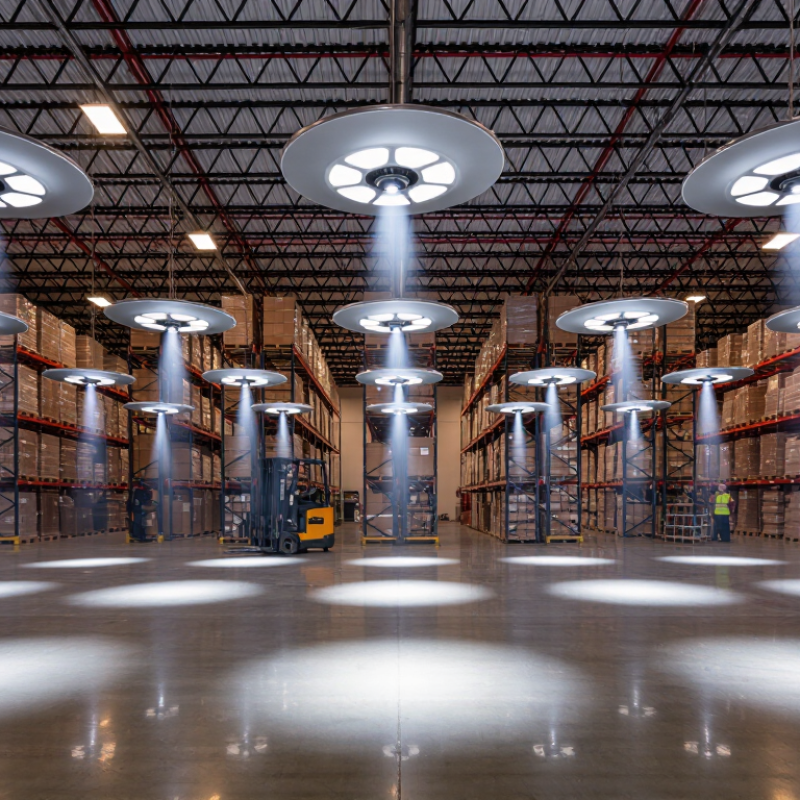
An LED UFO high bay light uses a compact round housing and a downward-facing optical system. Its shape supports broad heat dissipation and simple installation. In a recent warehouse retrofit, I compared mounting height, aisle width, and stored product colors before choosing the beam angle. A 90-degree beam suited narrow aisles, while a 120-degree beam covered open floor areas more evenly. Small details matter.

Check the light’s lumen output, color temperature, and color rendering index. Higher lumens do not always create better visibility. Excessive brightness can cause glare on polished floors or metal shelves. For workshops, neutral white light around 4000K often balances clarity and comfort. Food areas may require stricter cleaning and protection standards. Damp or dusty locations need suitable ingress protection. Always verify the rating from reliable technical documentation.

Thermal design also affects service life. Look for an aluminum heat sink, stable drivers, and safe operating temperatures. Motion sensors can reduce energy use in rooms with irregular occupancy. However, sensor settings may need adjustment after installation. My first warehouse project used a short detection delay, and lights switched off during brief loading pauses. That choice was not perfect. Measure actual illumination with a meter, not only from a specification sheet. Ceiling height, obstructions, and maintenance habits can change the result.

Matching Light Output and Beam Angle to Ceiling Height

Choosing an LED UFO high bay starts with mounting height, not wattage. A 12-foot ceiling needs different optics than a 30-foot ceiling. The Illuminating Engineering Society recommends designing industrial spaces around maintained illuminance, uniformity, task needs, and room conditions. Lumens alone cannot guarantee usable light.

As a practical starting point, 12–16-foot ceilings often suit 10,000–20,000 lumens with a 100–120-degree beam. At 16–25 feet, 20,000–30,000 lumens and a 60–90-degree beam can reduce dark gaps. Above 25 feet, consider 30,000–50,000 lumens with a narrower 30–60-degree beam. These ranges are not universal. A reflective white ceiling may spread light better than a dusty, dark surface. The U.S. Department of Energy’s 2020 U.S. Lighting Market Characterization reported that LEDs represented about 48% of installed lighting sources, but efficient equipment still performs poorly when poorly spaced.

Tips: Measure the mounting height, aisle width, and workplane before choosing a fixture. Use photometric files for a layout check. Narrow beams can create bright circles and dim edges. Wider beams improve coverage but may waste light on high ceilings. I have seen layouts judged by center-point brightness alone; that is a mistake worth reconsidering. Also verify maintained lumens, not only initial lumens, because dust, heat, and aging gradually reduce output. A lighting professional can confirm the final spacing and uniformity.

How to Choose the Best LED UFO High Bay Light? – Matching Light Output and Beam Angle to Ceiling Height

Ceiling Height Typical Application Recommended LED Light Output Suggested Beam Angle Approximate Coverage per Fixture Typical Mounting Spacing Recommended Illuminance Target Selection Notes
10–14 ft
(3.0–4.3 m)
Small workshops, retail areas, garages, and low-ceiling storage spaces 110°–120° wide beam Approximately 400–650 sq. ft.
(37–60 m²)
12–18 ft
(3.7–5.5 m)
30–50 footcandles
(320–540 lux)
Use a wide beam to reduce bright spots and improve uniformity at short mounting heights. Avoid excessive lumen output, which can create glare.
15–18 ft
(4.6–5.5 m)
General warehouses, service areas, indoor courts, and manufacturing spaces 90°–110° medium-wide beam Approximately 550–850 sq. ft.
(51–79 m²)
15–22 ft
(4.6–6.7 m)
30–50 footcandles
(320–540 lux)
A medium-wide distribution provides a practical balance between mounting height, fixture spacing, and visual comfort.
19–24 ft
(5.8–7.3 m)
High-bay warehouses, production floors, distribution centers, and loading areas 70°–90° medium beam Approximately 750–1,100 sq. ft.
(70–102 m²)
18–26 ft
(5.5–7.9 m)
30–50 footcandles
(320–540 lux)
Select higher output when the space has dark surfaces, tall shelving, or demanding visual tasks. A narrower beam can help maintain adequate light on the working plane.
25–30 ft
(7.6–9.1 m)
Large warehouses, industrial facilities, aircraft storage, and tall manufacturing areas 60°–80° narrow-to-medium beam Approximately 1,000–1,500 sq. ft.
(93–139 m²)
22–30 ft
(6.7–9.1 m)
30–50 footcandles
(320–540 lux)
Use a narrower beam when fixtures are mounted high or spaced farther apart. Check for overlap to prevent dark areas between fixtures.
31–40 ft
(9.4–12.2 m)
Very high warehouses, logistics hubs, industrial storage, and large open facilities 40°–60° narrow beam Approximately 1,300–2,000 sq. ft.
(121–186 m²)
26–36 ft
(7.9–11.0 m)
30–50 footcandles
(320–540 lux)
High-output fixtures and controlled optics are usually required. Consider glare control, forklift visibility, and lighting uniformity during layout planning.
Planning reference: Actual results depend on fixture efficiency, photometric distribution, mounting method, room dimensions, surface reflectance, obstructions, maintenance factor, and the required illuminance level. A lighting calculation should be completed before final installation.

Choosing the Right Color Temperature and Color Rendering

When choosing an LED UFO high bay light, color temperature should match the working environment. A 4000K lamp produces a balanced white appearance. It suits workshops, retail storage, and general production areas. A 5000K lamp appears cooler and more alert. It can support visual tasks in warehouses with high ceilings. Warmer 3000K to 3500K light may feel more comfortable in public or hospitality spaces.

Do not choose by Kelvin alone. The U.S. Department of Energy’s solid-state lighting guidance notes that LED products commonly range from warm white to daylight, while optical quality varies between products. Check the actual photometric report. I recommend comparing a sample beneath the planned mounting height. Dust, gray floors, and colored machinery can change the perceived result. It is easy to overestimate the value of very cool light.

Color rendering matters when workers inspect labels, wiring, finishes, or safety markings. A CRI of 80 is a practical baseline for many industrial areas. For color-critical inspection, consider CRI 90 or higher, while checking the R9 value for strong red reproduction. IES TM-30-20 adds Rf for color fidelity and Rg for color gamut, offering more detail than CRI alone. CIE 015:2018 also stresses consistent color evaluation and measurement conditions. Still, higher CRI can reduce efficacy. That trade-off deserves testing, not assumptions. A small mock-up may reveal uncomfortable glare or weak red tones before full installation.

For most industrial spaces, 4000K provides a balanced neutral-white appearance, while 5000K offers a cooler appearance that can improve visual contrast in storage and inspection areas. A CRI of 80 is commonly used for general industrial lighting; 90 or higher is preferable where accurate color identification is important. Always confirm the final choice with the visual task, surface colors, glare requirements, and applicable lighting standards.

Comparing Energy Efficiency, Lifespan, and Installation Requirements

How to Choose the Best LED UFO High Bay Light?

Choosing an LED UFO high bay light starts with energy efficiency, not appearance. Check lumens per watt, measured under real operating conditions. A fixture producing 150 lumens per watt can reduce electricity use in warehouses and workshops. However, advertised figures may reflect laboratory testing. Actual performance can drop with heat, dust, and poor voltage stability.

Lifespan matters just as much. Look for a rated life of at least 50,000 hours and a strong warranty. LED chips may last decades, but drivers often fail earlier. This is an easy detail to overlook.

Review the operating temperature range, surge protection, and heat-dissipation design. A cooler housing usually supports longer performance, especially in facilities running lights for twelve hours daily.

Tips: Match the mounting height and beam angle to the space. A narrow beam suits tall ceilings, while a wider beam reduces dark areas below. Confirm voltage, hook dimensions, and available wiring before ordering. Installation is often simple with a hook mount, but heavy fixtures may need lifting equipment. Always isolate power and follow local electrical requirements. I once underestimated ceiling access time; the light installation was quick, but cable preparation doubled the labor. That practical delay deserves a place in your budget.

Checking Safety Ratings, Controls, Warranty, and Total Cost

How to Choose the Best LED UFO High Bay Light?

Safety ratings should come before price. Check whether the fixture is certified for the installation environment, such as dry, damp, or wet locations. An IP65 rating can help in dusty facilities, but printed claims are not enough. Request a test report and verify the certification mark. The U.S. Department of Energy notes that LED lighting can use up to 75% less energy than incandescent lighting and last much longer. However, high heat, poor drivers, and voltage problems can shorten real service life. That detail is easy to miss.

Controls deserve careful attention. Occupancy sensors and daylight dimming can reduce wasted operating hours in warehouses with uneven traffic. DOE commercial-building guidance reports potential lighting-energy savings of roughly 20% to 60% from advanced controls. Choose compatible 0–10V or digital control systems, and check sensor coverage at twelve-meter mounting heights. Test one bay first. A control plan that looks perfect on paper may frustrate forklift operators.

Warranty language reveals total cost. Look for five-year coverage, clear lumen-maintenance data, driver terms, and stated ambient-temperature limits. LM-80 and TM-21 data are more useful than vague “50,000-hour” claims. Calculate watts, annual operating hours, electricity rates, installation labor, controls, and future replacement costs. The International Energy Agency estimates lighting uses about 15% of global electricity, so small efficiency gaps matter. My own checklist still has a weakness: it can undervalue maintenance access. A cheaper fixture is not cheaper when replacing it requires rented lifting equipment.