
Why Choose a Screw Centrifuge for Industrial Dewatering?
Industrial dewatering often begins with a difficult question: how can a plant remove more water without expanding its footprint? A Screw Centrifuge offers one practical answer. It combines continuous feeding, sediment transport, and mechanical compression inside a rotating bowl. The result is a compact system for municipal sludge, food-processing waste, mineral fines, and other challenging solids.
Dr. Stefan Reuter, a separation-technology specialist, describes the principle clearly: “Reliable dewatering depends on matching machine settings to the feed, not simply increasing speed.” That observation matters on the plant floor. A sludge stream may enter at only 2–4% solids. Inside the Screw Centrifuge, differential speed, pond depth, torque, and polymer dosage shape the final cake. Operators can watch the centrate change from cloudy gray to clearer water. They can also feel the process through rising torque or unstable vibration.
The strongest advantage is consistency. Continuous operation can reduce manual handling, simplify layout, and support predictable cake discharge. A properly selected unit may also lower downstream hauling volume. However, the machine is not a magic solution. Abrasive particles can accelerate wear. Poor polymer selection can weaken separation. Excessive speed may produce a wet cake instead of improving throughput.
That imperfection deserves attention. Equipment brochures rarely show the messy feed variations found in real plants. Pilot testing, maintenance planning, and experienced adjustment remain essential. Choosing a Screw Centrifuge means choosing a process strategy, not merely purchasing rotating equipment. Its value appears when engineering data, operating discipline, and honest performance expectations work together.
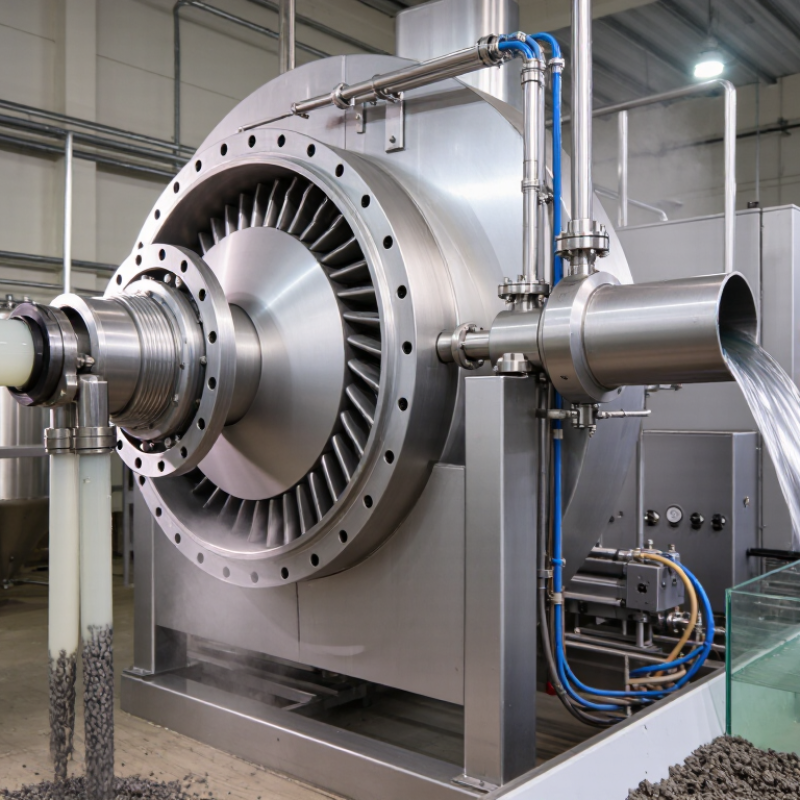
What Is a Screw Centrifuge and How Does It Work?
A screw centrifuge is a continuous dewatering machine for separating solids from liquid. It uses a rotating bowl and an internal screw conveyor. The bowl spins at high speed, creating strong centrifugal force. This force pushes heavier particles toward the bowl wall.
The process begins when sludge enters through a stationary feed tube. Inside the bowl, suspended solids settle against the rotating surface. The screw moves these solids toward the conical discharge end. Meanwhile, clarified liquid flows toward the opposite outlet. A small speed difference between the bowl and screw controls how quickly solids leave the machine. Slower movement often improves dryness, but it can increase torque and energy use. Operators may adjust the differential speed, feed rate, and liquid depth during testing.
Real performance depends on more than machine size. Sludge concentration, particle shape, temperature, and polymer dosage can change the result. A sample that dewaters well in the laboratory may behave differently at full scale. That is worth remembering. In daily operation, technicians watch vibration, torque, discharge texture, and liquid clarity. A sudden rise in torque may indicate overfeeding or poor solids transport. Excess water in the discharged cake can also reveal incorrect settings. Regular inspection of wear surfaces remains important, especially when the feed contains sand or abrasive particles. The equipment is compact and automatic, but it still needs careful adjustment and practical judgment.
Which Industrial Dewatering Challenges Can a Screw Centrifuge Address?
In industrial dewatering, the difficult question is rarely whether sludge contains water. It is how consistently equipment handles changing solids, flow, and grit. A screw centrifuge addresses this instability through continuous conveying and mechanical separation. Operators can adjust bowl speed, differential speed, and polymer dosage during production. Small changes matter.
At a wastewater site, thickened sludge may arrive at 2% solids in the morning and 4% after rain. That variation can affect torque, cake dryness, and centrate clarity. An experienced operator watches amperage and vibration, not only the final moisture result. These signals often reveal plugging or poor flocculation earlier. The machine also helps when floor space, wash water, or staffing is limited. Its enclosed design can reduce splashing and contain odors around the dewatering area. Continuous operation suits facilities that cannot pause for filter cloth changes or repeated batch loading.
Still, it is not a cure-all. Excessive grit can accelerate wear, while incorrect polymer mixing may produce wet cake. Feed screening, routine inspection, and calibrated dosing remain essential. Maintenance teams should check bearings, wear protection, torque trends, and conveyed solids. Skipping one inspection can become an expensive lesson. For food-processing sludge, industrial wastewater, and digested biosolids, the right setup depends on testing. Bench trials should measure capture rate, cake solids, centrate quality, and polymer demand. Results can shift with temperature and sludge age. Some installations still need a belt press or another process.
What Materials and Industries Are Best Suited to Screw Centrifuges?
A screw centrifuge suits materials that need continuous solid-liquid separation with limited operator attention. It handles municipal sludge, food-processing residues, starch suspensions, paper fibers, and many chemical slurries. Its rotating bowl creates strong centrifugal force, while the internal screw moves dewatered solids toward discharge. This design saves floor space and supports steady production.
The best applications have moderate to high solids content and particles that respond well to mechanical separation. Wastewater plants often use screw centrifuges for biological sludge and thickened sludge. Food facilities may process vegetable pulp, fruit residues, and fermentation byproducts. Mining and mineral plants can treat fine tailings when the machine has suitable wear protection. Chemical processors should check corrosion resistance carefully.
Material behavior matters more than industry labels. Fibrous sludge may wrap or create unstable torque. Very fine particles can produce wet cake or cloudy centrate without proper polymer selection. Operators should test feed density, particle size, temperature, viscosity, and settling behavior before installation. In daily operation, small changes in polymer dose can alter cake dryness noticeably. I have found that torque trends often reveal trouble before the discharge looks abnormal.
No centrifuge fits every slurry. Abrasive feed may shorten component life, while oily material can complicate separation. Cleaning access, noise, power demand, and maintenance skill also influence the choice. A pilot trial is wise, although it cannot reproduce every seasonal change. Real plant conditions are sometimes less predictable than laboratory results.
What Operational Benefits Does a Screw Centrifuge Provide?
Why Choose a Screw Centrifuge for Industrial Dewatering?
What Operational Benefits Does a Screw Centrifuge Provide?
A screw centrifuge provides steady dewatering in continuous industrial processes. Sludge enters through a feed pipe while rotating force separates solids from liquid. The screw conveyor then moves the captured solids toward discharge. This reduces pauses between batches and supports more predictable production schedules. That matters.
Operators can adjust bowl speed, differential speed, feed rate, and polymer dosage. These settings influence cake dryness, clarity, and throughput. A slower differential speed may produce drier solids, but it can also increase torque. Practical testing remains essential. Laboratory results do not always match a full-scale line.
The enclosed design limits splashing and reduces direct operator contact with wet material. Automatic torque monitoring can warn staff before overload conditions develop. Cake discharge is usually continuous, which reduces manual scraping around tanks and screens. The equipment also requires less floor space than several traditional settling units. Small details matter.
However, a centrifuge is not maintenance-free. Abrasive grit can wear conveyor flights and internal surfaces. Poor polymer mixing may cause cloudy liquid and unstable cake formation. Feed conditions can change hourly, especially in wastewater operations. Experienced operators inspect vibration, temperature, torque, and discharge texture together. I would not promise perfect dryness from one fixed setting. Careful adjustment, documented checks, and timely wear-part replacement usually deliver more reliable operation.
Why Choose a Screw Centrifuge for Industrial Dewatering? - What Operational Benefits Does a Screw Centrifuge Provide?
| Operational Dimension | Typical Screw Centrifuge Performance | Operational Benefit | Practical Consideration |
|---|---|---|---|
| Solids capture | Commonly about 95%–99% for suitably conditioned sludge and correctly adjusted operation. | Reduces suspended-solids loss in the centrate and improves overall dewatering stability. | Performance depends on feed characteristics, polymer selection, differential speed, and pond depth. |
| Cake dry-solids content | Often approximately 15%–30% dry solids for municipal and industrial sludge, depending on feed type. | Produces a more handleable cake and can reduce hauling, storage, and disposal volume. | Higher dryness may require optimized polymer dosing, lower throughput, or increased torque. |
| Continuous operation | Designed for continuous feed, separation, solids transport, and cake discharge. | Supports steady plant throughput and reduces interruptions associated with batch dewatering. | Stable feed flow and consistent sludge conditioning are important for reliable output. |
| Water and wash consumption | Generally uses less process water than belt filter presses because it does not require a continuously moving filter belt. | Can lower wash-water demand and simplify water-management requirements. | Routine flushing is still required, especially when processing sticky or fibrous materials. |
| Odor and aerosol control | An enclosed bowl and casing can substantially limit exposed sludge, splashing, and aerosol release. | Improves workplace cleanliness and supports easier integration with odor-control systems. | The centrifuge enclosure does not eliminate odors; ventilation and gas treatment may still be needed. |
| Footprint | A high-throughput centrifuge generally occupies a compact process area compared with many gravity-based systems. | Useful where plant space is limited or an existing dewatering line must be upgraded. | Allow additional space for polymer preparation, pumps, conveyors, access, and maintenance. |
| Labor requirement | Automation can regulate feed rate, differential speed, torque, and polymer dosing with limited routine intervention. | Reduces manual adjustment and allows operators to focus on monitoring and process control. | Operators still need training, inspections, routine cleaning, and verification of cake quality. |
| Noise and vibration | High-speed rotating equipment can generate significant noise and dynamic loads. | With suitable isolation and enclosure design, the equipment can be safely integrated into an industrial installation. | Foundation design, alignment, guarding, and periodic vibration monitoring are essential. |
| Maintenance profile | No filter cloth or belt replacement is required, but wear components such as scroll flights and wear liners require inspection. | Eliminates belt tracking and cloth-cleaning tasks common to some alternative systems. | A planned service schedule is necessary because abrasive or corrosive feed can accelerate component wear. |
| Feed flexibility | Can process many municipal, industrial, oily, and mixed sludges when the machine is correctly sized and conditioned. | Provides a versatile dewatering platform for changing production conditions. | Abrasion, oil content, fibers, grit, and chemical composition must be assessed before selection. |
| Process control | Torque, bowl speed, differential speed, feed rate, and polymer dosage can be monitored and adjusted. | Enables faster response to changes in sludge concentration and helps maintain consistent cake quality. | Control settings should be established through testing because no single configuration suits every sludge. |
Note: Performance figures are typical industry ranges for properly selected and operated equipment. Actual results vary with sludge type, feed concentration, polymer conditioning, temperature, equipment size, and operating settings.
How Should Businesses Evaluate and Maintain a Screw Centrifuge?
Why Choose a Screw Centrifuge for Industrial Dewatering?
How Should Businesses Evaluate and Maintain a Screw Centrifuge?
Businesses should evaluate a screw centrifuge using measured feed data, not catalogue promises. Record sludge flow, dry-solids percentage, temperature, viscosity, and polymer demand for several weeks. The U.S. EPA’s Biosolids Technology Fact Sheet: Centrifuge reports that centrifuge cake commonly reaches about 20–35% solids, depending on sludge type and conditioning. The Water Environment Federation’s Manual of Practice No. 8 also identifies feed variability as a major performance factor. A factory producing oily sludge may need different testing than a municipal plant.
Look closely at torque trends and vibration readings. A stable machine should not quietly consume more power each month. Compare capture rate, cake dryness, centrate clarity, and energy use per dry tonne. Ask for a pilot trial with your own sludge. It is not glamorous, but it prevents expensive optimism. Maintenance should include daily checks for leaks, abnormal noise, feed pressure, and polymer mixing. Inspect the scroll, bearings, wear protection, and differential-speed system according to operating hours. The U.S. EPA also emphasizes that poor conditioning can reduce solids capture and increase recycle loading. Operators should record every adjustment. Memory is unreliable.
Tips: Keep a simple log beside the control panel. Photograph unusual cake texture. Clean polymer lines before deposits harden. Do not increase differential speed automatically when centrate becomes cloudy; the real cause may be poor mixing, excessive feed, or worn internal parts. A maintenance schedule is useful, but actual operating data should challenge it.
Why Choose a Screw Centrifuge for Industrial Dewatering?
A screw centrifuge offers continuous operation, compact installation, and effective solid-liquid separation. The maintenance schedule below provides a practical planning guide for evaluating and maintaining a screw centrifuge in industrial service. Actual intervals should be adjusted according to feed characteristics, operating hours, vibration, wear, and the equipment manual.
How to use this chart: Daily inspections help identify abnormal vibration, leakage, noise, and cake-quality changes early. Weekly and monthly checks focus on lubrication, torque, wear, and gearbox condition, while quarterly and annual tasks support long-term reliability and performance.